Curves ahead: controlling light through free-form industrial optics
When light travels from A to B through a transparent material, it takes a path whose prescription has been well-known ever since Pierre de Fermat’s 1658 work, even when the material has arbitrary shape, so-called free-forms. A major challenge arises when the material is not only freeform but also opaque, like white light-emitting diodes (LED): how to control the transmitted light? This outstanding problem has recently been addressed by a multidisciplinary Dutch team from the Technical Universities of Twente, Eindhoven, and Delft in close collaboration with the well-known lighting industry Signify. The scientists made flat optical materials that could be bent as desired. They sent an incident laser beam whose wave properties were precisely controlled with a modulator device, akin to a projector, and dialled the modulator settings to maximize the transmitted light. To their amazement, they observed that freeform materials offer more control than flat samples. The new results are expected to improve advanced applications like high-precision metrology of integrated nano-circuits that drive the Internet of Things (IoT), or earth-observing detectors that are crucial in mitigating atmospheric pollution.
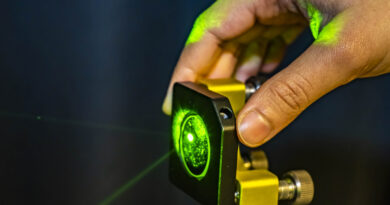
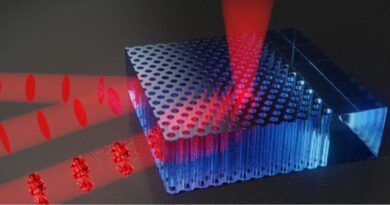
How to efficiently transport light from A to B? This deceivingly simple question is crucial to everyday devices such as video projectors, office lights, and optically secured bank cards. Over the last twenty years, scientists from all over the world, especially in the optical industry, have made great strides in the understanding and computation of light paths through free-form materials. The resulting free-form optics plays a major role in the design, development, and fabrication of daily-used optics like street lights or the lenses inside the mobile phone cameras. A different ball game arises when the optics is not only free-form but also opaque, like the white LED in Figure 1. Light inside such devices is scattered in all directions, a situation that eludes even the best free-form optics.

b) Scattering material made by the team, consisting of nanoparticles in a silicone matrix, fixed in a flat shape.
c) The same scattering material, fixed in a curve shape.
d) The 3D-printed holder that was used to reversibly bend the scattering material.
Conversely, light scattering is well understood with the tools of the complementary field of Nanophotonics. This field studies the properties of light whose direction gets lost inside opaque materials, such as foam, paint, and biological tissue. Recently, a major step was made by the realization that if one precisely dials the wave properties of the incident light, the transmission through opaque materials is substantially controlled and improved. Although innovative, this control was only studied for materials that are flat and planar, not free-form. Since free-form opaque materials have already widely proliferated in the light industry (for example the phosphor of white LEDs that are sold by the billions), the Dutch team set about to study this problem.
They made scattering materials consisting of titania nanoparticles (commonly used as a whitener in paper) embedded in silicone (commonly used for food containers and as hypoallergenic material). Next, they devised a nifty sample holder constructed by 3D printing (Figure 1d). The holder could reversibly bend the sample to a curved shape, or leave it in its original flat shape.
In their optical experiments, the team controlled the light waves emitted by a green laser using a device similar to a video projector or beamer, and they monitored the scattered light transmitted through the material using a highly sensitive camera.
When the incident light is not controlled, the picture taken by the camera is just a random pattern called a speckle (Figure 2a), but once the scientists turn on the modulation device, the light concentrates on a tight spot on the picture, just as if the white opaque object would be a high-quality lens. This modulation technique is called Wavefront Shaping (WFS), and a commonly used metric to know how well an opaque object can focus is the intensity enhancement, which shows how brighter the spot is after optimization – normally hundreds or thousands of times brighter!

a) Example picture of a speckle pattern. b) Comparison of enhancement of a curved object (red) and a flat object (light blue) for different diameters of the incident laser beam.
By studying the enhancement as a function of the bending of the material’s shape, they observed that a bent material achieves a higher enhancement than a flat material, regardless of how curved the object is related to the width of the laser beam (Figure 2b).
First author Alfredo Rates explains: “Our results challenge the current approach to wavefront shaping experiments since no fundamental scattering property was changed, except the macroscopic sample shape and the position of the lens. Nevertheless, with our proposed benchmark the increase in transmission enhancement is statistically significant. This is good news for applications and we hope it will encourage the community to study free-form in depth.”
Wilbert IJzerman from Eindhoven and Signify enthuses: “Our new results will improve advanced applications like high-precision metrology of integrated nano-circuits that drive the Internet of Things (IoT), or earth-observing detectors that are crucial in mitigating atmospheric pollution.”
Willem Vos is excited about the multidisciplinary collaboration: “It is wonderful that this study started from application-oriented questions from our industrial partners, which evolved into a study of a fundamental scientific question that involves advanced mesoscopic physics.”
The paper “Wavefront shaping through a free-form scattering object”, by Alfredo Rates, Ad Lagendijk, Aurèle Adam, Wilbert L. IJzerman, and Willem L. Vos, appears online and Open Access in the magazine Optics Express that is published by the leading Optical Society Optica, with DOI: 10.1364/OE. 505974. All data of the publication are available in the Zenodo database (maintained by CERN in Switzerland) with DOI: 10.5281/zenodo.7660084. This post is also available at the COPS website right here.