Shielding vacuum noise with 3D nanostructures
Many efforts are being made worldwide to realize nanostructures that control the omnipresent and unavoidable so-called vacuum noise, which affects many physical processes such as the emission of light. Nanostructures central to this novel technology are photonic crystals that manipulate the flow of light similar to how semiconductors manipulate electronic currents in a laptop’s chip. To date, it was always thought that such photonic crystals should be bulky and thick to shield qubits and light sources from this noise. In a recent computational study, scientists from Greece, USA, and the Netherlands find that even tiny photonic crystals effectively shield vacuum noise by 10x or more. The new insights lead to design rules for efficient lasers and LEDs, thin photovoltaic cells, or even optical quantum bits.
According to Quantum Mechanics, even empty space is not completely empty. Space is filled with short-lived particle-antiparticle pairs that appear and disappear, also known as vacuum fluctuations. Although their presence is subtle and cannot be observed directly, the fluctuations interact with atoms, acting as noise that induces an atom in a higher-energy state to drop to a lower energy state while emitting a photon. Hence, the manipulation of vacuum noise is crucial to design applications that employ light-emission control, photovoltaics, and quantum information processing.
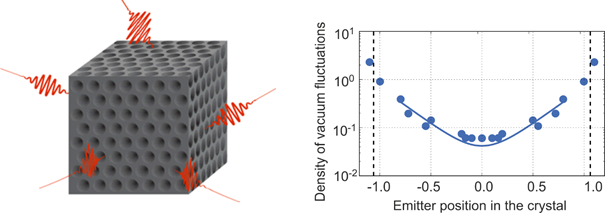
Ever since the 1950s, scientists have tried to understand and manipulate the vacuum noise by either enhancing or suppressing them, depending on the application. And the natural question that arose is: Is there any way to achieve really “empty” space? In other words, to even forbid the vacuum fluctuations? Photonic crystals can do just that: they control the vacuum noise by consisting of a periodic stack of layers or a periodic arrangement of holes in a bulk material (see Figure 1). It appears that vacuum fluctuations in a broad range of wavelengths are forbidden to enter the photonic crystal. This range of wavelengths is called the photonic band gap. This implies that an atom in an excited state inside an infinite photonic crystal would always remain excited! Therefore, no photons would be emitted.
In an infinite photonic crystal, the density of vacuum noise in the photonic band gap range is exactly equal to zero. However, in reality, photonic crystals are always finite, allowing the vacuum fluctuations to enter the crystal. This leads to the important question on the dependence of the vacuum fluctuations on the size and the position of the “atoms” inside the crystal.
The team of scientists from Greece, the Netherlands and the USA have tackled this question by computing the density of vacuum fluctuations at different positions inside a three-dimensional photonic crystal with the diamond-like structure (Figure 1, left). The crystal consists of two orthogonal arrays of holes of air in silicon. It appears that the deeper we move inside the crystal, the smaller the density of vacuum fluctuations becomes; the density decreases exponentially with depth (see Figure 1 right). Lead author Mavidis says: “Our results provide simple design rules for the applications of nanostructures to improve light emission, absorption in solar cells, or to control optical quantum bits. Already a 10-fold shielding of vacuum noise can be achieved if one chooses positions as little as 500 nanometer into the crystal.“
The team is excited about the consequences of their new discovery. Prof. Kafesaki explains: “our observation that even thin photonic crystals are powerful devices implies that companies can develop products much faster, while saving precious resources.” Prof. Vos, co-founder of the new Twente company Quix (motto: “the fastest way to a quantum future”) remarks: “the observation that even thin structures are functional is great for quantum information processing. In this field, we struggle to counter the unavoidable noise from vacuum fluctuations.” And Prof. Economou, enthuses: “We find this news fantastic since apparently thin crystals already control the emission of light that is central to laser devices! The current results imply that thin photonic crystal devices are highly exciting for many different applications”.
The team:
The research has been performed by Charalampos Mavidis MSc, Dr. Anna Tasolamprou, Prof. Maria Kafesaki, Prof. Eleftherios Economou from the Foundation for Research and Technology – Hellas (FORTH) Institute on Crete, Greece, by Dr. Thomas Koschny and Prof. Costas Soukoulis from both the D.O.E. Ames Laboratory and the Iowa State University in Ames, Iowa, U.S.A, and Dr. Shakeeb Bin Hasan and Prof. Willem Vos from Complex Photonic Systems (COPS), MESA+ Institute for Nanotechnology, University of Twente, The Netherlands. Meanwhile, Dr. Hasan has joined ASML, the world’s leading lithography company in Veldhoven, Netherlands.
The research is supported by the European Research Council ERC Advanced Grant no. 320081 (PHOTOMETA), the European Union’s Horizon 2020 Future Emerging Technologies call (FETOPEN-RIA) under grant agreement no. 736876 (project VISORSURF), the General Secretariat for Research and Technology and the H.F.R.I. PhD Fellowship grant (GA. no. 4894) in the context of the action “1st Proclamation of Scholarships from ELIDEK for PhD candidates, and by the Nederlandse Organisatie voor Wetenschappelijk Onderzoek (Perspectief Program “Free Form Scattering Optics”, FOM program “Stirring of Light!”); and MESA+ section Applied Nanophotonics (ANP). Work at Ames Laboratory was supported by the US Department of Energy, Oce of Basic Energy Science, Division of Materials Science and Engineering (Ames Laboratory is operated for the US Department of Energy by Iowa State University under contract No. DE-AC02-07CH11358.
Further information can be obtained from:
Charalampos Mavidis MSc, email: mavidis@iesl.forth.gr, phone: +30 2810 39 1917
Prof. Willem Vos, email: w.l.vos@utwente.nl, phone: +31 53 489 5388
Information on the World Wide Web:
The paper is entitled “Local density of optical states in the three-dimensional bandgap of a finite photonic crystal” and is being published in Physical Review B in June 2020 (https://journals.aps.org/prb/abstract/10.1103/PhysRevB.101.235309). A reprint of the paper is available from the COPS chair at https://nano-cops.com/publications/article/the-local-density-of-optical-states-in-the-3d-band-gap-of-a-finite-photonic-crystal. It is also available on the Cornell preprint server Arxiv at: http://arxiv.org/abs/2002.12029
Source: https://nano-cops.com/